
You Cool? (Part 2) If it’s brown, lay down….sometimes
This is part 2 of a story that started by mistaking some deer for hungry bears.
In Part 1, I shared a hike on the Teton Crest Trail and the landscape with a variety of wildlife, which underscored how much of a “shared space” the backcountry is. This second installment shifts from our personal narrative to a broader discussion of bear safety and current research
Understanding Bear Behavior
The old adage, “If it’s brown, lay down. If it’s black, fight back,” while catchy, is an oversimplification that can be misleading and even dangerous. While sometimes applicable, this rhyme ignores the nuances of bear behavior. Bear biologist Wes Larson correctly points out that playing dead—though effective in defensive attacks (often by brown bears protecting cubs)—can be risky in predatory attacks (more common with lone male black bears)2. Larson emphasizes that passively surrendering control can have dire consequences. (Link to Larson Video) Playing dead might be crucial in one situation, while fighting back might be necessary in another.3 Learning to interpret bear behavior is paramount. (Link to video on black bear attacks) It’s unsettling to abandon a simple mnemonic, but understanding the why behind a bear’s actions—defensive, predatory, or simply curious—is crucial.3
Bear Behavior: Species vs. Individual
While statistics suggest most violent black bear attacks are predatory (often by males)4 and most brown bear attacks are defensive (often by mothers protecting cubs)5, these are general trends, not guarantees. Both species can inflict serious harm, and individual behavior varies. Like us, bears are individuals, and recognizing this complexity is key for safe navigation of their territory. If you’d like to learn more, there’s good information through any of the links to papers and videos at the end of this article, along with extracted summaries of the content that contributed to my research here.
Deterrents: Shoot, Spray, or Bark?
The debate over the best bear deterrent—bear spray or a firearm (and perhaps dogs)—continues. Most bear experts I follow prefer bear spray, citing its effectiveness in deterring curious bears and resulting in fewer human injuries.2, 6, 9, 10, 11 My personal choice is bear spray, especially as I spend more time in black bear country than grizzly. This isn’t to say lethal force is never an option, but it shouldn’t be the first, or only, choice, especially with black bears, where unprovoked aggression is less common.
Disagreement on bear spray vs. firearms exists even among gun enthusiasts.12 One study favors guns as the primary deterrent13, but its methodology (focusing only on firearm incidents and appearing on a gun blog) raises concerns about bias and lacks peer review.12 Efficacy of Firearms for Bear Deterrence in Alaska includes firearm malfunctions and user errors, while Handgun or Pistol Defense Against Bear Attack omits these, potentially inflating its success rate. Both studies acknowledge underreporting due to legal ramifications of shooting grizzlies in most regions of the U.S.
While “Efficacy of Firearms for Bear Deterrence in Alaska” and “Efficacy of Bear Deterrent Spray in Alaska” share authors, they are not comparative studies. The latter shows pepper spray’s effectiveness against curious bears, but not charging bears.9 The authors later clarified that in predatory, unstoppable attacks, a firearm might be the only option.14 However, most human-bear interactions are driven by curiosity, or defense, but not predation.
Bear biologists advocate for both humans and bears, while some gun enthusiasts prioritize human safety alone. We should consider our actions’ ecological consequences. Making noise, traveling in groups, and managing attractants are the best defenses, minimizing interaction altogether.
Bringing a dog for perceived safety might be counterproductive, as research suggests they can provoke aggressive encounters.7, 8 The human desire for control can override research, reminding us to acknowledge our biases.
Remember, research is a process, not a destination for “truth.” It’s about gathering data, understanding probabilities, and influencing positive outcomes. As backcountry use increases, clearer patterns may emerge.
Awareness over Ignorance
Violent encounters increase with human expansion into bear habitat, but aggression is rare, often territorial, defensive, or related to hunger/food defense. Evidence suggests human choices contribute to violent encounters. All backcountry travelers should know how to respond to an encounter, or better yet, avoid them.
Regardless of your gear, we’re not always the alpha. Good decisions influence outcomes, not guarantees.
Can you distinguish bear distress from aggression? Mistaking one for the other is easy. A bear might simply be passing through or curious. Educate yourself before an interaction. Observe your surroundings, travel in groups, avoid attractants, and react appropriately. Deterring encounters benefits everyone.
(See citations below for important excerpts from the research)
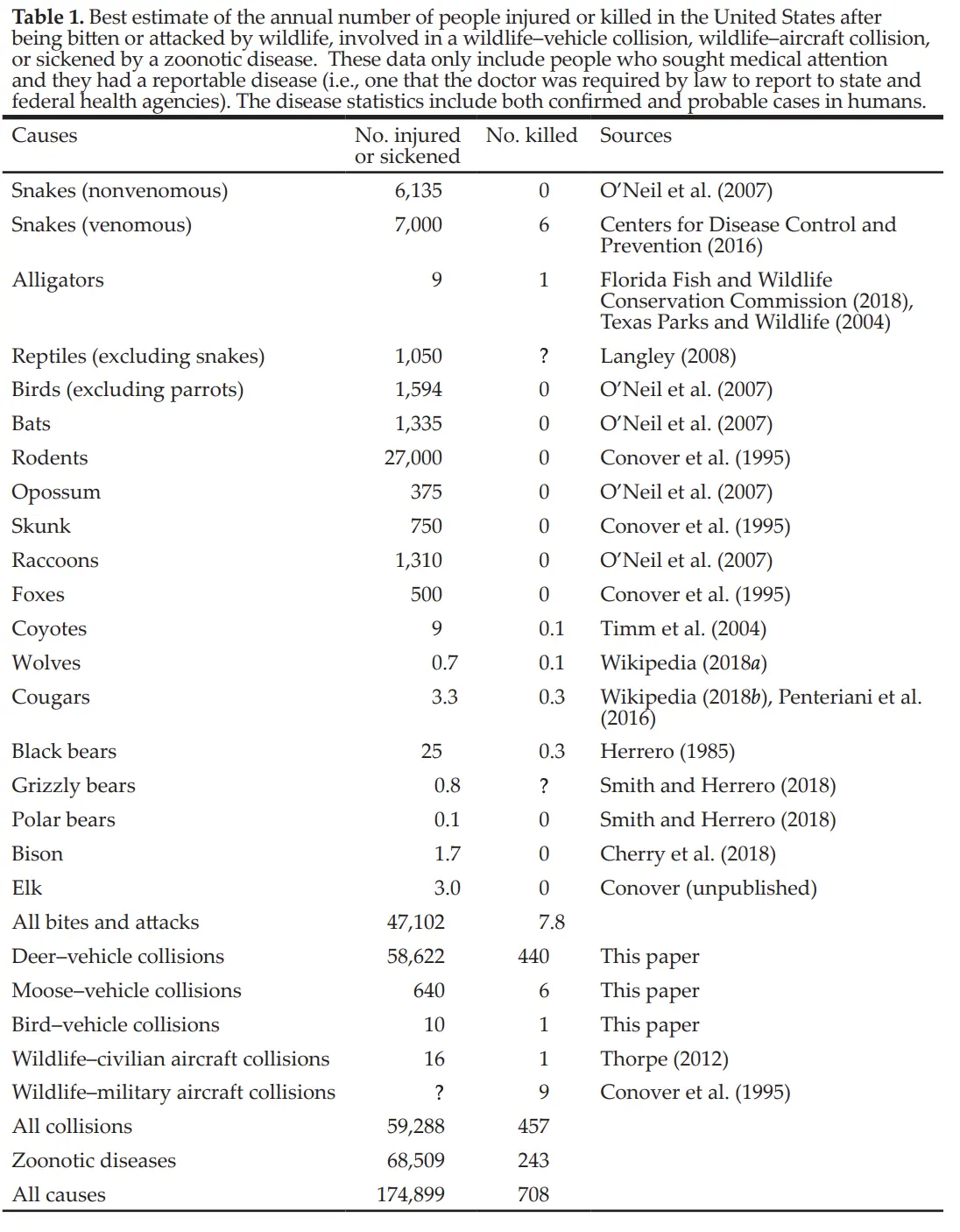
Somewhat of an afterthought to this article, here’s a useful chart that identifies where bears land in the spectrum of danger to humans in the U.S. It turns out the deer ARE more dangerous than the bears - just not on the trail 1. It’s true that “you’re more likely to die on the way to the trailhead than on the trail itself.”
*Always store food at least 200 ft from your camp, and cook at least the same distance away.
-
Numbers of human fatalities, injuries, and illnesses in the United States due to wildlife
“Over 47,000 people annually in the United States sought medical attention after being attacked or bitten by wildlife, and approximately 8 people died annually. Most bites were by snakes, birds, rodents, and raccoons (Procyon lotor). Each year, wildlife–vehicle collisions resulted in >59,000 human injuries and >440 human fatalities…These figures do not mean that wildlife populations should be reduced; they do indicate, however, that wildlife biologists have an opportunity to serve society by preventing human injuries, morbidities, and fatalities resulting from wildlife.”
Link to Resource -
Bear Safety with Wesley Larson
“A gun can be a very effective way to stop a charging or attacking bear. However, even the most steady-handed gunslinger might get a little shaky with 600 pounds of fur, claws and teeth rushing towards him at 30 mph. A poorly placed shot can get you in even more trouble than you started in, and a gun might be better used as a backup to your bear spray.”
Link to Resource -
Characteristics of non-fatal attacks by black bears: conterminous United States, 2000–2017”
However, much of the current messaging still advises people, in generalities, to play dead with a brown bear and fight back with a black bear. This is likely because many brown bear attacks are defensive and most fatal black bear attacks are predatory. Yet our results show that more defensive non-fatal attacks by black bears occur than fatal attacks. We agree that when and if it can be determined that an attacking black bear is acting defensively, playing dead is likely more effective at stopping an attack and results in less severe injuries regardless of species.“
Link to Resource -
Fatal Attacks by American Black Bear on People: 1900–2009
“Of fatal attacks, 91% (49 of 54) occurred on parties of 1 or 2 persons. In 38% (15 of 40) of incidents, peoples’ food or garbage probably influenced the bear being in the attack location. We judged that the bear involved acted as a predator in 88% (49 of 56) of fatal incidents. Adult (n==23) or subadult (n=10) male bears were involved in 92% (33 of 36) of fatal predatory incidents, reflecting biological and behavioral differences between male and female bears. That most fatal black bear attacks were predatory and were carried out by 1 bear shows that females with young are not the most dangerous black bears“
Link to Resource -
Brown bear attacks on humans: a worldwide perspective
“Here, we investigated brown bear attacks (n = 664) on humans between 2000 and 2015 across most of the range inhabited by the species: North America (n = 183), Europe (n = 291), and East (n = 190). When the attacks occurred, half of the people were engaged in leisure activities and the main scenario was an encounter with a female [brown bear] with cubs. Attacks have increased significantly over time and were more frequent at high bear and low human population densities.“
Link to Resource -
Bear Spray vs. Bullets Which offers better protection?
“…investigations of human-bear encounters since 1992, persons encountering grizzlies and defending themselves with firearms suffer injury about 50% of the time. During the same period, persons defending themselves with pepper spray escaped injury most of the time, and those that were injured experienced shorter duration attacks and less severe injuries.”
Link to Resource -
Characteristics of non-fatal attacks by black bears: conterminous United States, 2000–2017”
(p.191) Most attacks were defensive (52%), while 15% were predatory and 33% were food-motivated. Of defensive attacks, 85% were by female bears, and 91% of those females had young. Of predatory attacks, 95% were by male bears, and of food-motivated attacks, 80% were by male bears. Forty percent of defensive attacks by female bears involved dogs (Canis lupus familiaris). Sixty-four percent had an attractant present during the attack and 74% indicated there were reports of property damage by bears or of bears getting a food-reward in the area prior to the attack
Link to Resource -
Characteristics of non-fatal attacks by black bears: conterminous United States, 2000–2017”
(p.199) …when a person was walking or hiking with a dog (21/41 attacks where it was known they had a dog present) and had a surprise encounter with a female bear (12/12 of those walking or hiking with a dog where the bears sex was known, 11/12 of which had cubs present). Many of these resulted in a severe attack (6/11 of those where severity was known). It was reported by 3 victims that they initially fought back but then changed strategies to play dead when they realized fighting back was not effective. Upon playing dead, the bear backed away. In 2 of those cases, the victim then attempted to leave the area, which triggered the bear to attack again… Understanding these scenarios is important for developing management and education strategies that reduce personal risk.“
Link to Resource -
Efficacy of Bear Deterrent Spray in Alaska
“Red pepper spray stopped bears’ undesirable behavior 92% of the time when used on brown bears, 90% for black bears, and 100% for polar bears. Of all persons carrying sprays, 98% were uninjured by bears in close-range encounters. All bear inflicted injuries (n=3) associated with defensive spraying involved brown bears and were relatively minor (i.e., no hospitalization required).”
Link to Resource -
Efficacy of Firearms for Bear Deterrence in Alaska
“A total of 444 people and at least 367 bears were involved in these incidents. We found no significant difference in success rates (i.e., success being when the bear was stopped in its aggressive behavior) associated with long guns (76%) and handguns (84%). Moreover, firearm bearers suffered the same injury rates in close encounters with bears whether they used their firearms or not.”
Link to Resource -
Is Bear Spray Better than a Gun? Here’s What 352 Aggressive Bear Encounters Taught Us…
Link to Resource -
Science Says bear spray is more effective than guns, right?
Link to Resource -
Handgun or Pistol Defense Against Bear Attack: 73 cases, 96% Effective
Link to Resource -
Does Bear Spray Work? The science is clear, right? Not so fast, according to, well, science. “If you’re competent, then a firearm is a valuable, time-tested deterrent,” says Tom Smith. He goes on to reference the case of Todd Orr who was famously mauled twice by the same bear here back in 2016. Despite employing the spray, the bear still managed to attack Orr, then later stalked and attacked him again. “Bears accurately shot don’t have that option,” says Smith. “Game over.” But user competency is the largest determining factor in the successful use of a firearm. “When a person is competent with firearms—and I mean competent under pressure—it is an effective deterrent I highly recommend,” he says. “Conversely, those with little to no firearm experience shouldn’t rely on a firearm to save them from a close encounter with a bear.”
Link to Resource