
This is Part 2 of a 3-part series debunking rattlesnake myths. Part 1 covered the claim that juvenile rattlesnakes are more dangerous than adults.
Update, May 2026: Since Part 1 of this series published in April, a third fatality has been reported in California. Please keep your hands away from spaces you cannot see into and practice the safety strategies discussed below when on the trail.
Last weekend I guided a 3-day rock climbing trip outside of Barstow, CA. I know the area well, but my preferred camps were taken, so I set up at the interface of the campground and the open Mojave. Within the first 24 hours I counted seven snakes: five Southwestern Speckled Rattlesnakes, a Mojave Green Rattlesnake, and a Red Racer. By the end of the trip we were somewhere between 13 and 15 before we stopped keeping track. More than I’ve seen in some entire years. Not surprising for a high-activity snake year, but a lot of safety to manage alongside twelve new climbers.
On the first evening, my assistant guide set her pack down next to some brush while we rigged climbs. She walked back to rummage for something from her pack but quickly backed away as she heard rattling from below. She’d been standing within inches of a large snake that had claimed the shade of her pack as a perfectly reasonable place to spend the evening. No strike. Just the warning.
I walked over, confirmed the snake’s position and my safety, and lifted the pack clear from above. The snake rose up in defense, found nothing (I was several body-lengths away by then), tasted the air, and dropped back down. It slunk off into the brush. Already half gone, it rattled just once more, as if to say, “and stay away!”
No packs touched dirt after that.
Of the dozen-plus snakes we saw that weekend, only a handful rattled at us. Most of them were responding to a curious male student who’d gotten too close. The rest didn’t care we were there.
One morning I walked deliberately toward a snake, well outside strike distance, trying to move it along from the road. It had sheltered under a student car and the sun was now barely up. The snake barely registered me. Snakes are ectotherms, meaning they can’t generate their own heat or regulate their temperature. Cold means slow, and slow means metabolically limited. It made a half-hearted attempt at moving and then just lay there.
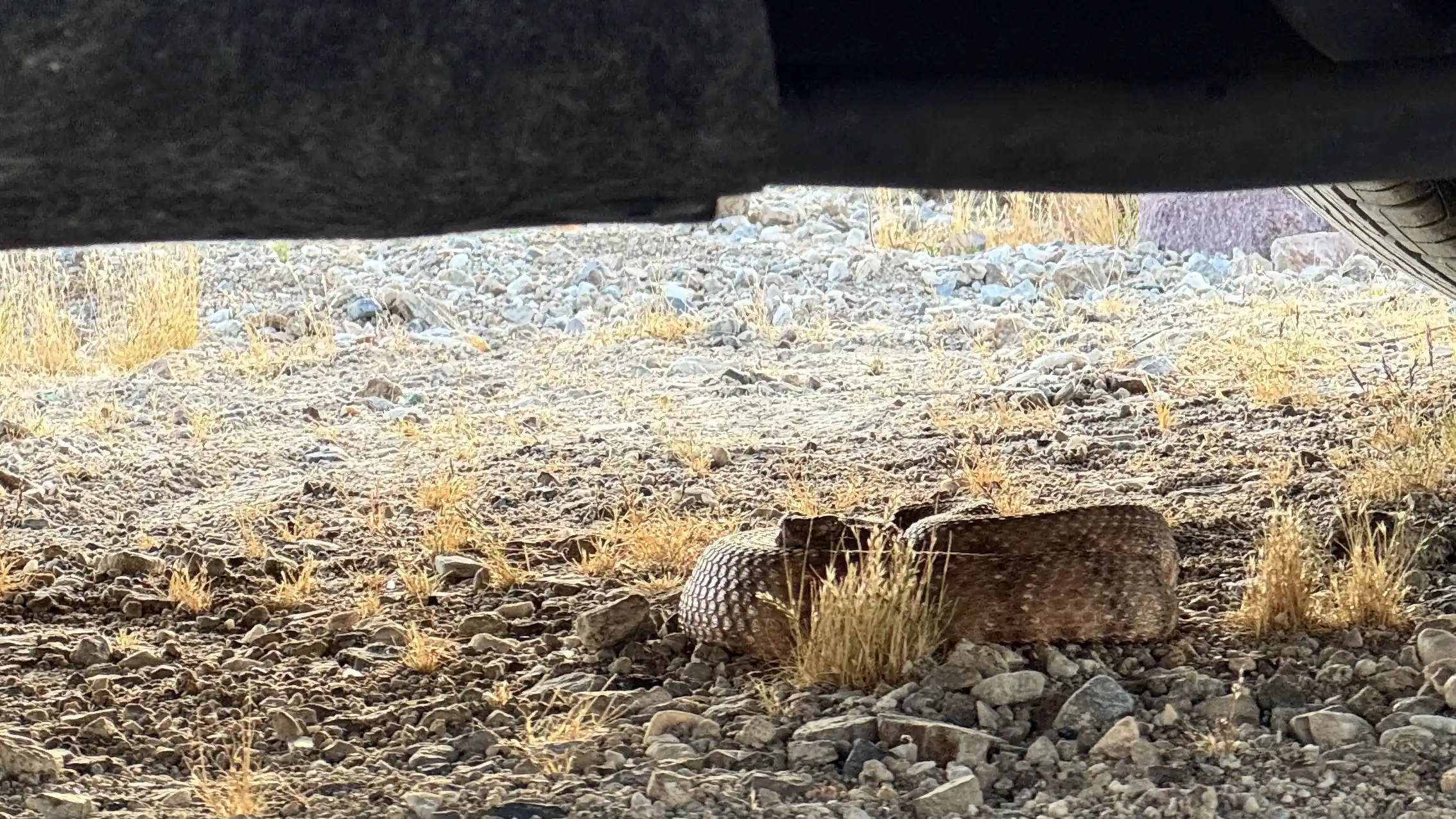
Now put that same snake in some trailside brush. In this scenario, I walk past without knowing it’s there. It doesn’t rattle. I have a nice hike. There’s nothing to report.
Which brings up a belief that’s circulating: rattlesnakes are evolving to lose their rattles. The logic is clean. Aggressive humans hear a rattle, find the snake, kill it. The quiet snakes survive and breed. Repeat for a few generations and you have a silent rattlesnake. It’s the kind of argument that spreads easily because it confirms what people already fear. Unseen danger, lurking.
The problem is you can’t test a negative. How do you study something that didn’t happen? Every hiker who walked past a silent rattlesnake and had a perfectly fine afternoon is invisible data. No scare-story, nothing to report. Whether that snake chose not to rattle, or physically couldn’t, is unknowable. There’s nothing to measure since, well, nothing happened.
But we can test the other side of it: how, when, and why does a rattlesnake actually rattle? Those questions have answers, and the answers put the silent-rattle theory in a difficult position on two fronts.
The First Problem: Time
Evolution doesn’t work in decades. The selective pressure from human encounters is statistically negligible against the multi-million year process that produced the rattle. We are not the primary threat it evolved to address. Coyotes, hawks, roadrunners, and the hooves of large mammals were, and those pressures have been running longer than our species has been walking upright.
To appreciate how negligible that individual pressure is, consider what organized, industrial-scale rattlesnake killing actually looks like. Rattlesnake roundups have operated across the midwestern and southern U.S. since the 1950s. Hunters extract snakes directly from dens using hooks, or by pumping gasoline into burrows, a practice called gassing. Live snakes are transported to public events and slaughtered en masse. Sweetwater, Texas alone has killed more than 250,000 rattlesnakes over the life of its event. The record year, 2016, processed 24,262 pounds of Western Diamondbacks. By the 1990s, Texas roundups were removing an estimated 125,000 snakes from the wild annually. Snakes taken this way are extracted during winter dormancy or early spring emergence, when they are cold, slow, and largely defenseless.
Rattles are irrelevant to whether a snake survives a den raid like those in Sweetwater. Predation of this magnitude is the primary pressure on rattlesnake populations, not a hiker on a trail purportedly protecting the community. On scale, we are a greater threat to the snakes than the other way around.
The Second Problem: What the Rattle Actually Is
The second requires understanding what the rattle actually is. Most people picture a noisemaker that goes off the moment something moves. It is not.
In 2021, a study published in Current Biology by Forsthofer et al. found that rattlesnakes use frequency modulation to actively manipulate the depth perception of approaching mammals. When a threat approaches, the snake rattles at a low frequency, slowly. As the threat crosses a specific distance threshold, it abruptly shifts to high-frequency mode, jumping from around 40 Hz to upward of 100 Hz. That sudden spike creates an auditory illusion: people underestimated their distance from the snake when it rattled at higher frequencies. The faster rattling tricked the brain into perceiving the snake as closer than it actually was, generating a false safety margin by manipulating your spatial awareness. The rattle is doing more than making noise. It is influencing your perception of where you are relative to the snake.
If you’ve spent enough time around snakes, you may have noticed this. Some rattle aggressively from a distance. Others slow-rattle until you get close, then accelerate. Others move off without a sound. Still others simply refuse to budge, stubbornly holding the trail. Snakes are responding to the situation.
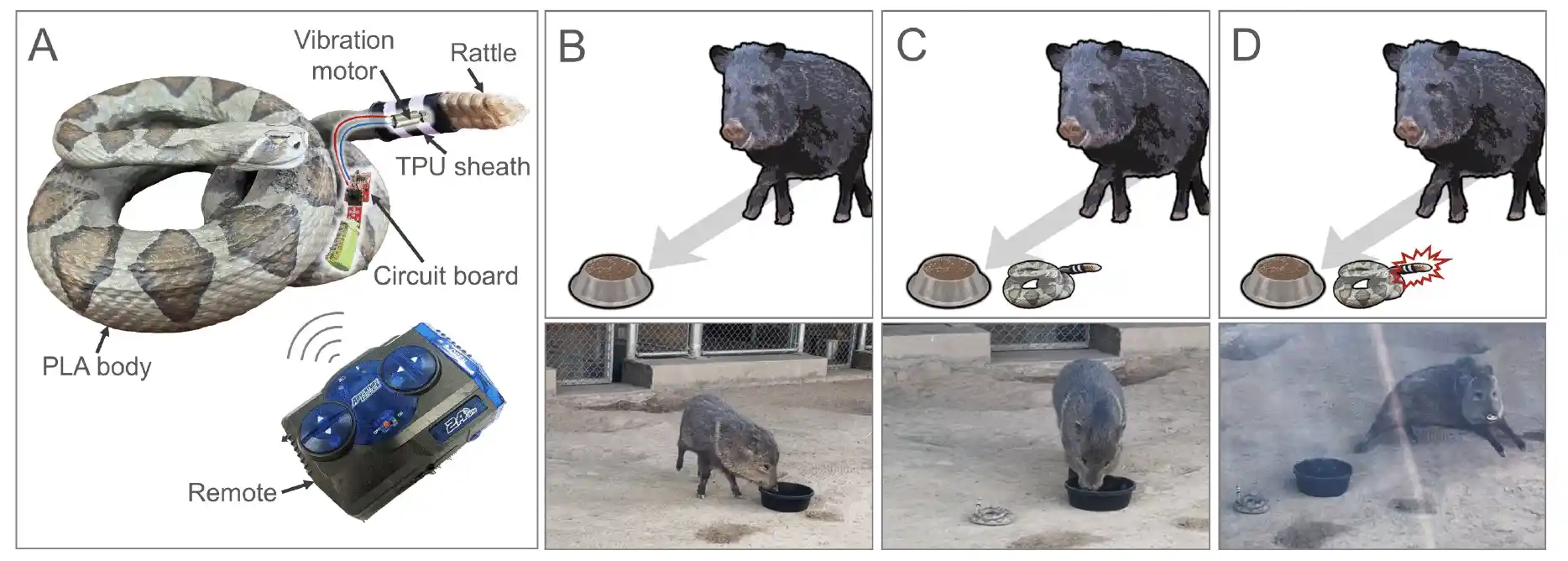
The rattle works well beyond humans. In March 2026, researchers planted a 3D-printed robotic rattlesnake into the enclosures of 38 different animal species and measured responses to both the visual presence of the snake and the sound of its rattle. Animals sharing a geographic history with rattlesnakes showed immediate, dramatic fear responses upon hearing it, particularly species most likely to trample or attack a snake in the wild. The rattle evolved for those animals, but you share the fear response it was built to exploit. Your ancestors had good reason to be scared. Snakes are dangerous creatures.
But a rattlesnake is not discarding millions of years of evolutionary engineering because a few humans went out and found individual snakes to kill.
Tail vibration under threat is nearly universal across the Viperidae family and common across the Colubridae family, which is the largest snake family on earth with over 1,700 species. Gopher snakes do it. Rat snakes do it. King snakes do it. None have a rattle, but all vibrate their tails against dead leaves or gravel, producing something close enough to a rattle to give pause, though much quieter. A 2016 study by Bradley Allf confirmed what this implies: tail vibration predates the rattle. The rattle is a specialized, amplified addition to an ancient response, one so broadly present across snake families that it existed long before any snake had rattles to amplify the tail vibration. The behavior and the rattle are independent. You can have one without the other.
What’s Actually Going On
Before getting to why, it helps to see what camouflage actually looks like in practice.
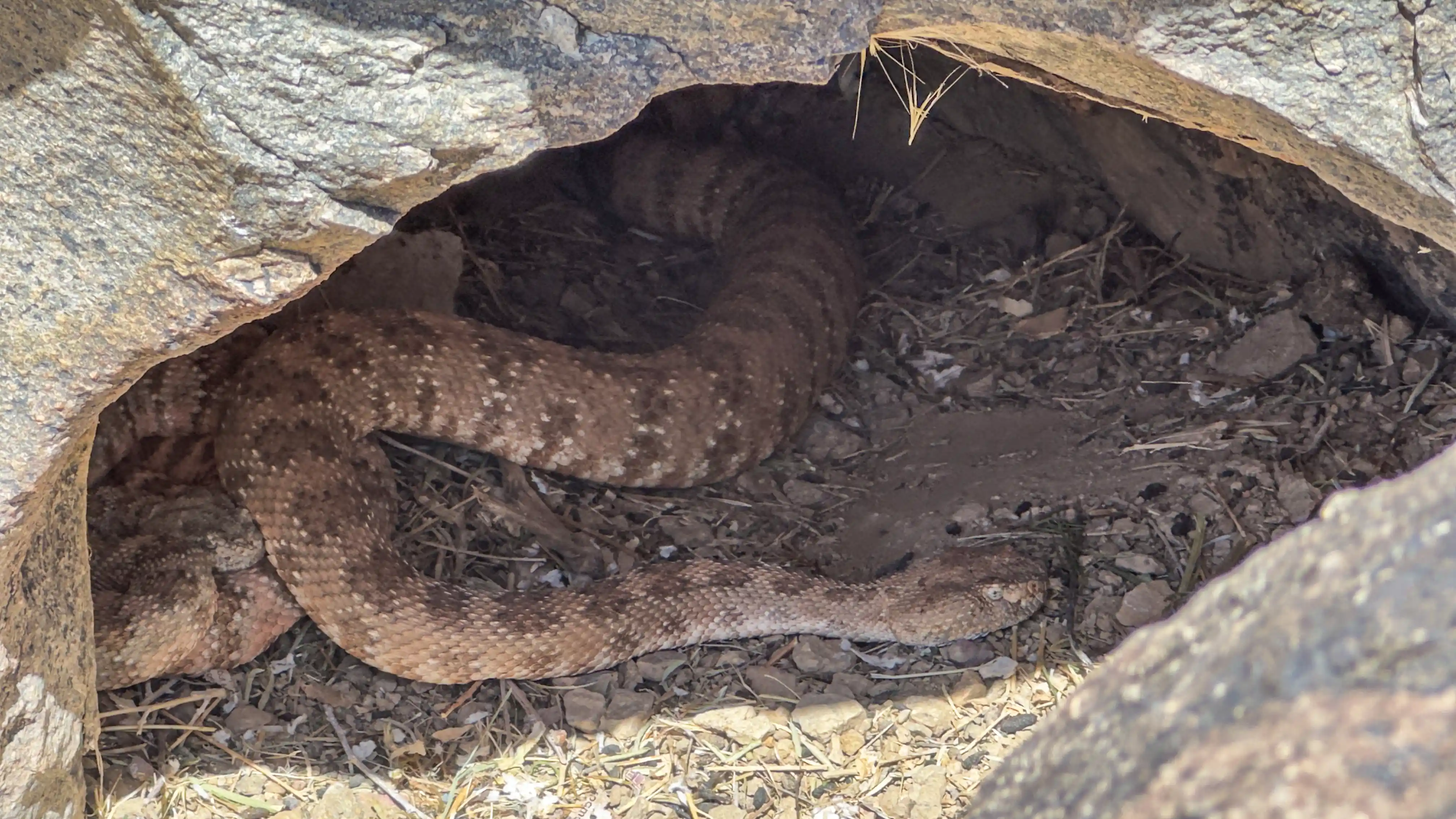
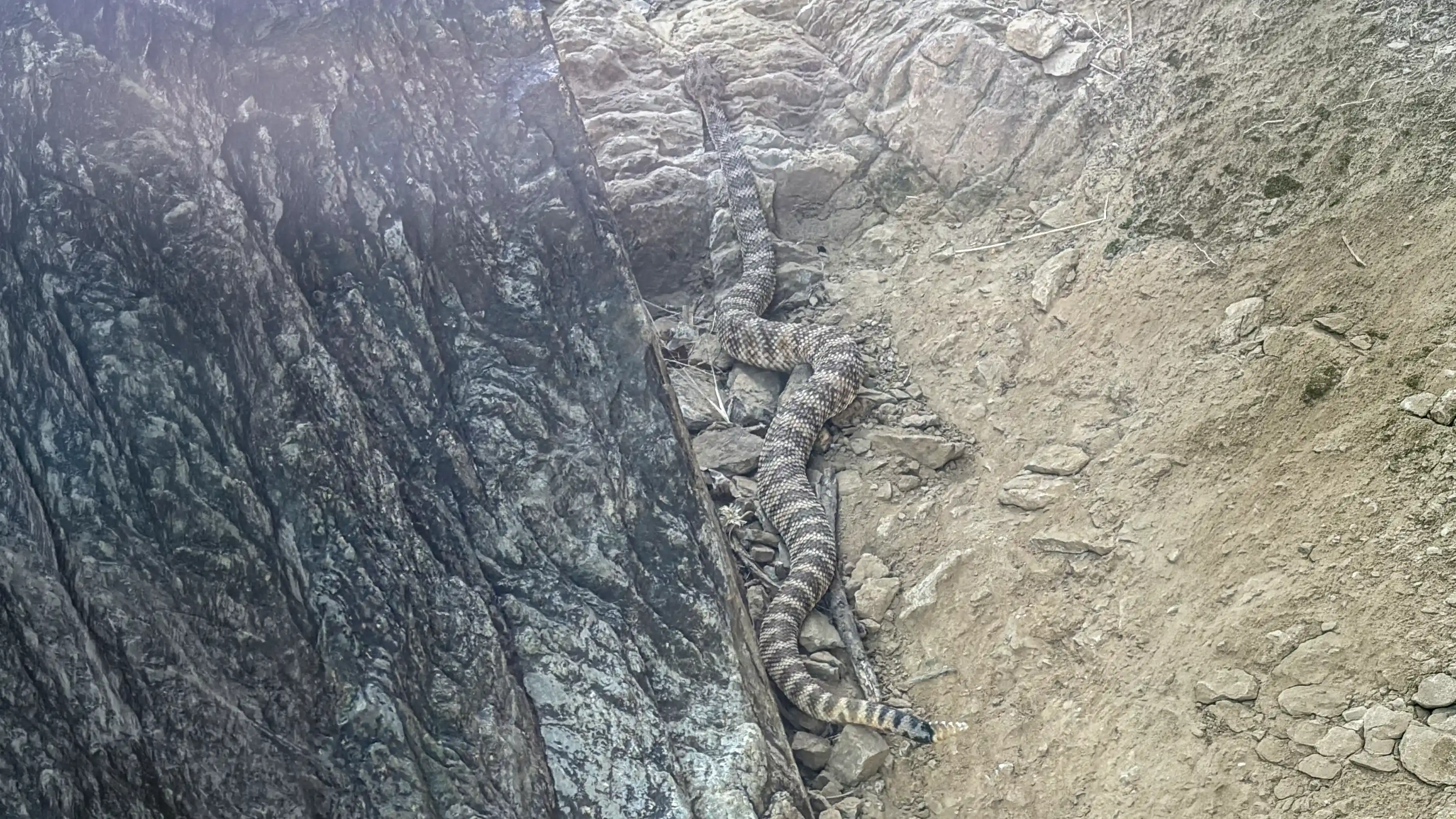
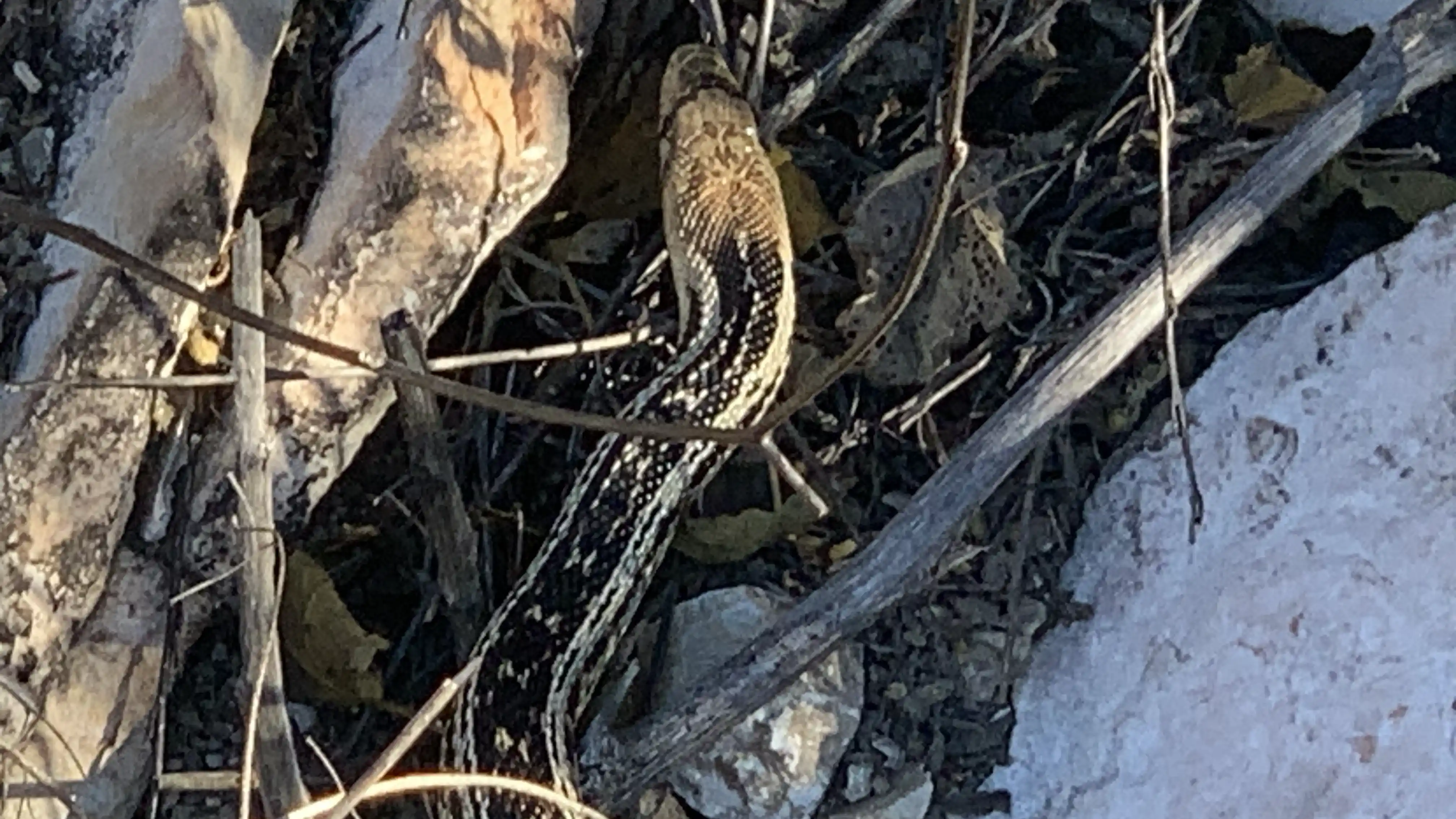
Both photos are from my climbing trip in May 2026. The snake coiled in the rock den is a Southwestern Speckled Rattlesnake. The one in the canyon is a Mojave Green. Look at how completely their coloring matches the ground beneath them. Camouflage is the primary strategy. The rattle is deployed when staying invisible stopped working.
So if a snake’s not rattling at you on the trail, what’s actually going on? It might be one of four things.
The rattle is compromised. Rattles take a beating in the wild. They get caught on rocks, snagged in brush, and insects chew through the keratin in dens. Missouri Department of Conservation herpetologist Dr. Jeff Briggler notes that a rattlesnake missing its rattle might just be a snake that had a rough year and broke its tail.
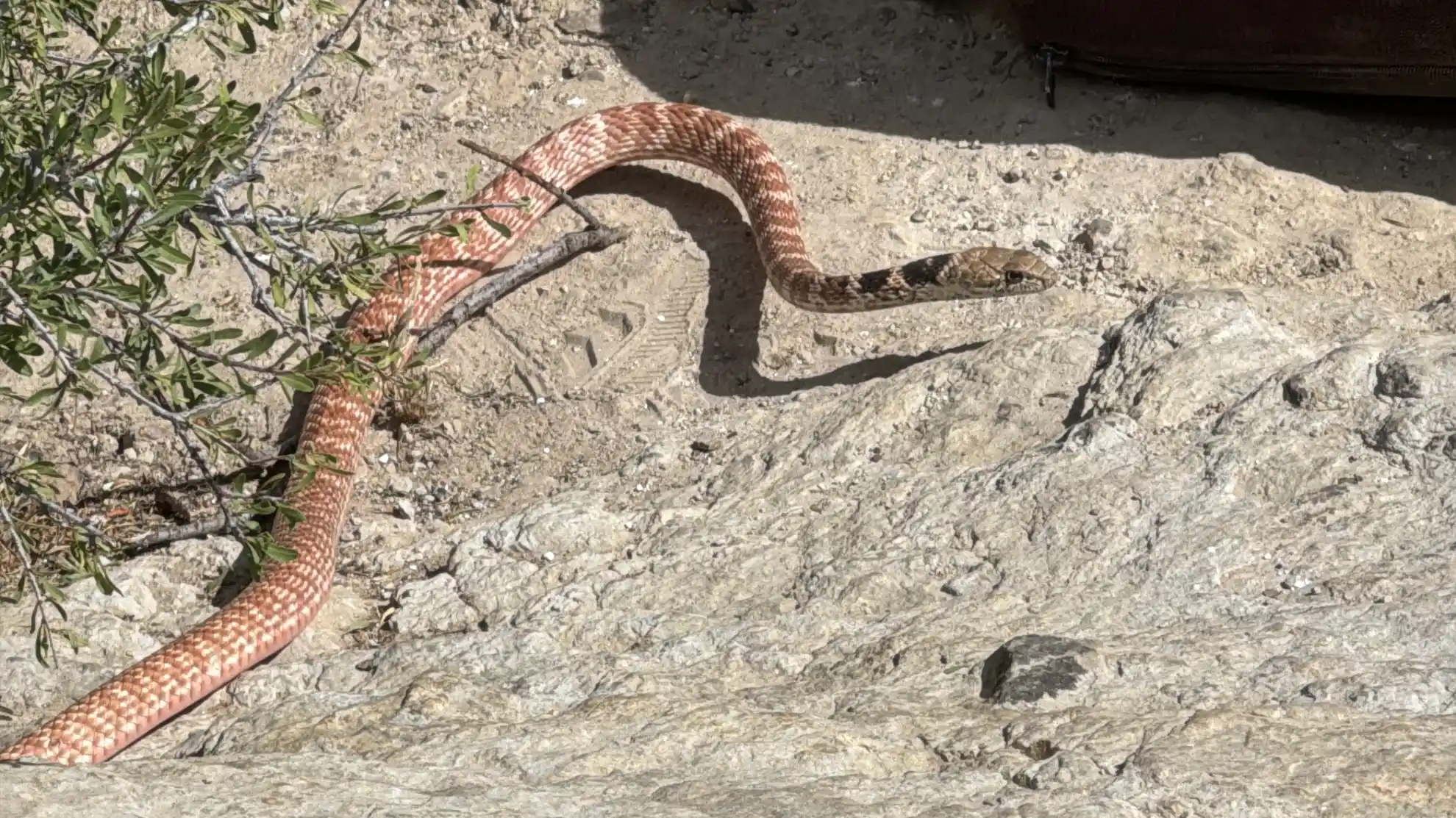
You’re looking at a different species. On my climbing trip, two of the snakes we encountered were Red Racers. Along with Gopher Snakes, these species use rattlesnake mimicry as a defense strategy, and carry enough visual similarity to produce a genuine fear response. If a snake didn’t rattle at you, one possibility worth considering is that it’s simply not a rattlesnake.
Metabolism. Snakes are ectotherms. They rely entirely on external heat sources to function. The snake I walked up to that barely registered my presence had been denning under a car overnight. Cold means slow across every physical system, including the muscles that drive the rattle. A snake on a cold morning is operating on low capacity. That matters for how you read the encounter.
The snake made a decision. The behavior of vibrating the tail under threat is ancient, present across dozens of species with and without a rattle, and it is a tool, not a reflex. Its use gets evaluated against context every time. A rattlesnake in a low-traffic wilderness area and a rattlesnake on the edge of a busy park trail are operating in fundamentally different environments, and they respond accordingly.
In high-traffic corridors, a snake can habituate to constant foot traffic. Human footfall becomes background noise, a known quantity rather than a threat. Camouflage and stillness were always the first line of defense for rattlesnakes and for the hundreds of species that don’t have rattles. The rattle is a last resort, deployed when camouflage didn’t work.
This is behavioral plasticity, the ability to modify responses based on environmental learning, and it has been documented across reptile species. The snake under the backpack ran the same calculation: taste the air, assess, decide, find the exit to safety. Issuing a warning is a choice that risks engagement. Every living thing is predisposed to find the safer option first.
The rattle gets deployed when the calculation tips. When the threat is close enough, persistent enough, or physically encroaching enough that staying quiet doesn’t work. That’s what happened to my students when they crossed the threshold of the snakes’ comfort.
Your ears are one tool for navigating the world. Leaning on them as the primary one creates a false sense of what’s actually available to you. A safer approach is straightforward: train the rest of your senses to help keep you safe.
What To Do About It
Use trekking poles. Both of them.
Part 1 of this series established why in full, but the short version: the tap-tap-tap of a pole strike produces a vibration signature that reads as large mammal, not prey. Pace them in front of your feet as you walk. Strike brush before you move through it. Probe compressed sections before you commit to them.
Read the trail.
Brush encroaching on the path, rocky outcrops narrowing the walkway, a compression point where the trail pinches to single-file. These are prime hunting positions, designed by geography to funnel rodents and humans alike into a predictable lane. A rattlesnake is an ambush predator running a patient strategy: coil at the trail edge, wait for something the right size to pass within range. Compressed trail is where that strategy pays off. Slow down at these points. Probe before you walk through.
The same logic applies to hands and feet. Keep them out of spaces you cannot see clearly: brush, rocky crevices, ledges, the shaded gap under a boulder. The data on rattlesnake bites is unambiguous here. The majority of envenomations in the U.S. happen to young-adult through middle-aged males, predominantly on the hand. Bites on the hand are the sign of a hand going somewhere it had no business going.
Know what you’re looking at.
Racers and Gopher Snakes use rattlesnake mimicry as a defense, including body posturing, tail vibration, and enough visual similarity to produce a genuine fear response. Distinction is worth learning: a rattlesnake has a triangular head noticeably wider than the neck, vertical elliptical pupils, and a rattle segment at the tail tip. Red Racers are slender, narrow-headed, and fast-moving. Gopher Snakes are heavier-bodied but carry none of the distinct head flare.
Give them the trail.
If you see a rattlesnake, your scanning protocol worked. Stop, establish distance, observe. The snake will most likely do one of two things: ignore you entirely, or rattle a bit and move off. If it holds its position silently, it has decided you are not worth the energy. You can retreat or give it a wide berth. At minimum the length of its outstretched body. If it holds its position while aggressively rattling, retreat. It’s not worth it. Admire it if you can manage it. It’s a marvel.
The goal of this series has never been to make you unafraid of rattlesnakes. Fear is a reasonable response to a venomous animal. It’s a useful reaction. The goal is to replace the fear that makes people kill snakes on sight, or stop hiking altogether, with the understanding that makes coexistence straightforward. You are a large mammal in a landscape that was theirs before it was yours. Make your presence known. Watch where you put your hands. Look down.
The snakes are doing their part. And they would rather not meet you either.
Looking to build more trail confidence? Check out our Upcoming Workshops or join the Five Miles Further Community.
Academic Sources & Further Reading
The Rattle
Frequency modulation of rattlesnake acoustic display affects acoustic distance perception in humans
The multimodal display of rattlesnakes is a deterring signal that works best with sympatric species
Rattlesnake Rattle Frequency and Distance Perception (Video)
Origins of the Rattle
Snake Identification & Behavior
Rattlesnake Rattles — Missouri Department of Conservation
Rattlesnake Roundups
Rattlesnake Round-up (Wikipedia)
Sweetwater Snake Roundup Still Rattles Wildlife Advocates
Rattlesnake Roundups (Yale Environment 360)
Rattlesnake Roundup: A Texas Community Tradition (NPR)
Rattlesnake Roundups (rattlesnakeroundups.com)