
Comfort Is Your Enemy
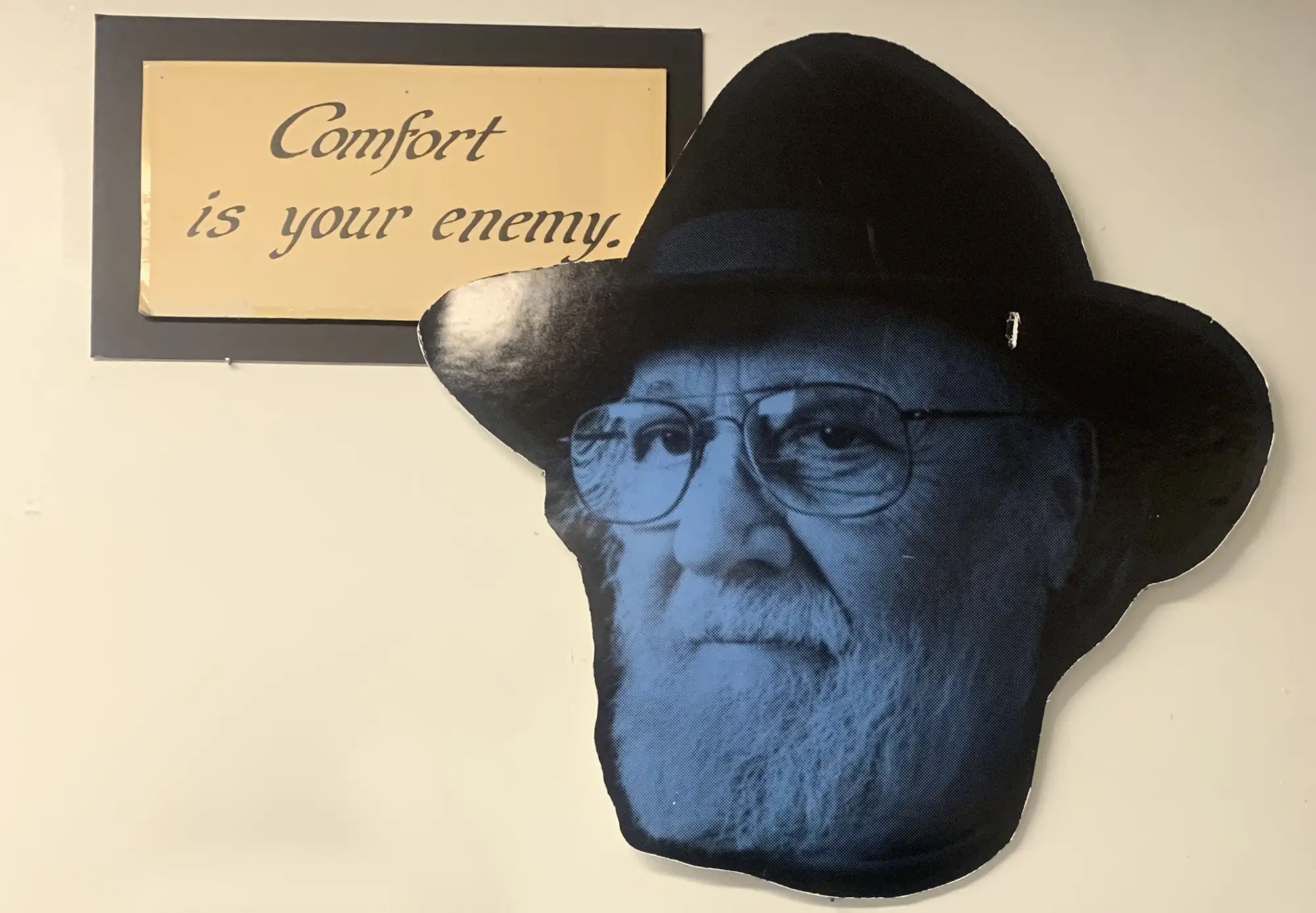
The first (and arguably) most important lesson you would have learned, had you been in the Moorpark Community College photography program, was announced by a sign on the studio wall stating, “Comfort is your enemy.” It was the guiding phrase of our mentor, John Gray, who repeatedly assured us that we could still have nice cars and comfy couches, but if we wanted to do anything that mattered, we’d have to reject convention.
I landed in the photography program because I needed a way to stay legally in the U.S. The easiest means was to gain temporary status under a foreign student visa. The primary problem was: “what to study.” After some catalog flipping - and a complex process involving a dartboard and two drunk monkeys - I chose photography.
Foreign student visas and out-of-state tuition were not cheap. It was not a comfortable process. But being part of that remarkable community changed my life, and I still benefit from its influence today.
The Gap
The pursuit of Art is a perfect allegory for life at large: outcomes are inherently uncertain; you need a good system; you sign up for a process and see where it takes you. It’s best practiced at the stable, but uncomfortable edge.
Finding motivation in art can be difficult with its false starts and anxiety-ridden late nights. Then there’s the utter drudgery of working through details that are all inalienable parts of the process. If you don’t know your goal - where you’re headed and why - your staying power can wear thin.
You need to know WHY you’re doing, not just WHAT you’re doing.
The irony of motivation is that we are all motivated to do EXACTLY what we’re doing. Those who are motivated to sit on the couch, sit on the couch. Those who are motivated to overindulge in food, drink, or consumption, do so. Those are motivated to stay safe, generally are. Many of us have known people who stay in abusive relationships, simply because they were motivated by certainty - even certainty in unhappiness - over uncertainty in loneliness.
You are motivated to do exactly what you’re doing at this moment. So am I, as I write these words.
For growth to happen, some uncertainty - and some discomfort - is necessary. If you want to experience something different than what you’re experiencing now, you first have to acknowledge a gap is there between where you are and how you want to feel.
For most people, that’s a deeply uncomfortable idea. If that’s you, good. Comfort is your enemy.
People who are motivated to sit on that couch luckily have a friction-free path to receive their reward. All they have to do is amble over and have a seat. That said, I don’t recommend it. There’s no growth there and, if indulged too much, it won’t end well. People who are motivated to stay safe are usually motivated by certainty. The human brain loves novelty and too much routine - too much control - usually returns very little novelty or surprise. Have you ever felt oddly satisfied by rearranging your furniture? Me too. That’s your brain firing new synapses by a shift in routine.
Here’s a simple experiment: on your next commute home, take a different route. Better yet, take a few random turns and see where you end up. You’ll likely feel energized just to be in a neighborhood you’ve never seen before. Neat.
Certainty can bring stability and safety, but too much means stagnation and decay. A ship is safe in its port, but that’s not what ships are for.
Feeling First
For many people, knowing “what” you want is elusive. It can be easier to identify a feeling first or, better still, identify something you are currently experiencing but are no longer willing to abide by. So how do you get motivated when you don’t even know what motivates you? Start with the feeling.
Motivation is much more like habit than we realize. It’s progressive. You take a small step, then another, and then, if it’s right, you can feel in your bones that there’s no going back. You set a foot on the path out of curiosity, and then you find the real motivation on the way - you feel motivated to continue - because it feels right.
The first step doesn’t need to be a physical one. If you want change, you just need to know, or feel, that you want a future that is different from your present. Luckily, it’s easier to know how it feels rather than know the exact details of what it is. Feelings are more powerful than logic.
Your Brain Is Protecting You
Our brains are not designed to trek off into the unknown. They are systematically designed to keep us safe:
- run when you feel threatened;
- don’t trust that stranger;
- hide from predators at night.
The more you practice being safe, the more your brain systematizes that response. If you imagine something hard enough - something that scares you, for instance - your body physically responds as if it’s actually true. Fight or Flight kicks in, cortisol is released, and you are consumed with seeking safety, not growth. It’s a very functional system doing precisely what it’s meant to do: keep you alive. It’s the logical system wired for stasis. It’s good at its job.
Now, here’s the cool part: the opposite is also true. You can imagine how great something in your future will feel and, if you focus and practice it, your brain will start mapping the same but opposite emotional response. Instead of releasing cortisol and inducing stress, you’ll receive serotonin and dopamine. Your brain will begin physically wrapping and insulating new and real neural pathways, making it progressively easier to pursue your goal. It’s a system you can leverage if you pay attention. Double Neat.
Interesting, but so what? What are we supposed to do with this?
Think of it like this: motivation is the willingness to invest in your future self. The willingness to sacrifice something you might consume now (like a bit of comfort), so you can have more of what you want in the future (like your goal). Motivation is imagining yourself in your most perfect experience, and knowing there’s a gap between where you are now, and where you want to be.
Motivation is simply finding a route to fill that gap.
It becomes the narrative you get pulled toward. You don’t need to haul yourself out of bed and “get to the gym,” you just need to acknowledge that you want a particular thing or feeling or outcome and then show up and do the work necessary to get there. The big challenge is that no one can feel it for you, and that’s a bigger barrier than most people are willing to acknowledge.
If you feel uncomfortable with this idea, good. You’re supposed to. Comfort is your enemy. That’s ownership. That’s growth.
The Gap Between Knowing and Doing
So that’s why people get stuck. But understanding the problem is not the same as walking the path. Knowing that “comfort is your enemy” is the first step. Building a system to defeat it is the second.
In our community this month, we are moving from theory to practice by designing our goals and building structure around them. Because if you don’t have a target you can see, you don’t have a clear goal.
For the Community: The full exercise is now live and ready to go. It contains:
- The Wayfinding Goal Statement templates.
- The Ship of Theseus “Anti-Goal” exercise.
- The discussion thread to post your goals for accountability.
Log in to Access the full article
Not a Member? If you are ready to reject convention and start wayfinding, join the Join the Community.
Let’s go find your best self.